



Determine three-layer atmospheric electric fields using MGMR3D
- Physics Education Department, School of Education, Can Tho University, Campus II, 3/2 Street, Ninh Kieu District, Can Tho City 94000, Viet Nam
- Department of Physics, Can Tho University, 3/2 Street, Ninh Kieu, Can Tho City 94000, Viet Nam
- Department of Education and Training, 3/2 Street, Ninh Kieu District, Can Tho City 94000, Viet Nam
Abstract
Introduction: Measuring atmospheric electric fields is a difficult task because of the volatility of thunderstorms and the lack of control over direct measurement methods such as balloons. MGMR3D is a semi-analytic code that can be used to determine the structures of atmospheric electric fields during thunderstorm conditions indirectly. However, it is required to check whether the MGMR3D results have a good agreement with those provided by the microscopic model, CoREAS, in three-layer electric field cases.
Methods: Using MGMR3D and CoREAS, we compared the intensity and linear and circular polarizations of radio emissions due to extensive air showers given by the two codes.
Results: This work shows that a good agreement was obtained for air showers passing through more complicated electric field structures.
Conclusion: This means that one can use MGMR3D to extract details on the structures of the atmospheric electric fields in thunderclouds.
Introduction
When a cosmic-ray particle strikes the Earth's atmosphere, it soon collides with nitrogen or oxygen in the atmosphere and from that, generates many secondary particles. A cascade of secondary particles is called an extensive air shower. Due to the Earth's magnetic field, the charged particles in the air shower are affected by the Lorentz force and deflected in opposing directions, forming a transverse current. Since the number of charged particles changes as a function of height, the transverse current also changes and thus emits radio radiation1, 2, 3. In turn, the radio emissions can be used to determine the properties; the primary particle initiated the air shower4. In thunderstorm conditions, the electric fields in the thunderclouds are large. Therefore, they influence the air showers passing through the thunderclouds. The transverse current and its radiation also changes 5, 6. As a result, both the intensity footprints and polarization footprints of the air showers passing through thunderclouds differ from those of the air showers in fair-weather conditions. The intensity and polarization footprints can be used to extract the structure of the atmospheric electric fields in thunderclouds. The radio mechanism in both fair-weather and thunderstorm conditions can be performed using both microscopic and macroscopic models. The microscopic models that simulate the radio emissions from extensive air showers accurately are ZHAires 7, and CoREAS8, a plug-in of the simulation code CORSIKA9. In CoREAS, there is an EFIELD option that can be turned on to simulate atmospheric electric field conditions10. These codes calculate the contribution to the total radiation of each individual charge separately.
The trajectory of the charge was cut up into short segments and for each segment, the radio emissions were calculated. On the other hand, MGMR1, EVA2, and their latest successor MGMR3D11 are examples of macroscopic codes where the radiation field is derived from the Li´enard-Wiechert potential where the four-current is parametrized. MGMR3D is much faster than CoREAS simulations. Therefore, it can be used to extract atmospheric electric fields, as mentioned above. MGMR3D agrees well with CoREAS for fair-weather showers and for cases where extensive air showers pass through two-layer electric fields 11, 12. However, in thunderclouds, there are usually three different charge layers; the structure of the electric field in the thunderclouds usually contains three layers. The aim of this study was to check the agreement between the macroscopic code MGMR3D and the microscopic code CoREAS for air showers passing through three-layer structures.
Materials-Methods
Strong electric fields in thunderstorm conditions exert an electric force that is usually stronger than the Lorentz force caused by the Earth's magnetic field on the charged particles in air showers. The air showers and their radio emissions are affected by this electric force. Based on these effects, the electric field can be decomposed into two components. The first component is parallel to the shower core, , which can accelerate the electrons or positrons depending on the orientation of the atmospheric electric field . Therefore, the charged particles will gain energy and generate new particles. The number of charged particles increases. However, since these increasing charged particles have low energy, the frequency range of their radiation is much lower than the one of interest. Thus, we set the electric field component. The second component, , is perpendicular to the shower axis. This component influences both the magnitude and direction of the transverse current formed by charged particles. Although the total number of charged particles in the air shower does not change, the net force increases. As a result, the magnitude of the current and its radiation also rises. The intensity of the radiation is linearly dependent on the square of the current's magnitude up to 50 kV/m. Beyond this value, the drift velocity increases so much that the longitudinal velocity falls so as to keep the total velocity from not exceeding the velocity of light. Thus, the particles will trail much further behind the shower front, and their emission will not add to our interested frequency range 6. Since electric fields do not usually point in the direction of the Lorentz force, the direction of the net force was different from that of the Lorentz force. Therefore, the transverse current changed in orientation which resulted in a change of the polarization footprint.
MGMR3D is a semi-analytic code that calculates the radio emissions of a parameterized transverse current in an air shower using Maxwell equations. This parametrization is based on the output of CoREAS simulations where the radio emissions from the air showers passing through strong electric field regions is simulated. The effects of the atmospheric electric fields on the radio radiation from air showers have been studied in detail in6. MGMR3D is not based on the Monte Carlo model. It requires less time to compute the radiation from a shower. To validate the performance of MGMR3D for the cases of three-layer electric fields, we fitted the radio footprint of showers simulated with CoREAS to that of MGMR3D. First, we simulated air showers passing through the region where there are three different layers of atmospheric electric fields. Each layer i started at the height h. The strength and orientation of the electric field in the layer were kept unchanged and defined by E and . The radio pulses of each air shower were simulated for a star-shaped layout of antennas which had eight arms and the center at the shower core. There were 20 antennas on each arm, and the distance between two antennas along one arm was 25 m in the shower plane. The radio radiation was filtered at our frequency range of interest, between 30—80 MHz. In addition, in order to fit both the intensity and polarization footprints, for each antenna we used the real-valued Stokes parameters expressed as
v is the direction of the air shower and B is the magnetic field of the Earth. ε is the complex-valued signal where i is the sample number (at 2×10 samples per second).
The radiation was summarized over n = 11 samples around the peak of the signal. The intensity of the radio emission was defined by Stokes I. The linear polarization angle was determined using Stokes Q and Stokes U
and Stokes V gives the amount of circular polarization. Secondly, we performed 20 runs in MGMR3D with different values of Xmax from 500 g/cm to 900 g/cm with a step size of 20 g/cm. While keeping Xmax fixed, we fitted the nine parameters of the three-layer electric fields. The next step was choosing the fitting run having the smallest reduced χ where the reduced χ to be minimized in MGMR3D is defined as
Here f is the normalization factor and σ is the uncertainties. Lastly, we compare the electric fields which are plugged into CoREAS and the fitted electric fields obtained in MGMR3D.
Results
Event 1
Figure 1 shows the comparison between the Stokes parameters obtained from CoREAS and those from MGMR3D for Event 1. As seen from this figure, the CoREAS and MGMR3D results agree rather well. The plot in the bottom panel shows that the discrepancies between the intensity obtained from CoREAS and that from MRMG3D are about 2σ where σ denotes one standard deviation error. The radio-intensity footprint, the left panel of Figure 1, shows a clear ring structure with a diameter of about 150 m.
The parameters of the electric fields and the value of Xmax are given in Table 1. The value of Xmax obtained from MGMR3D and the true value from CoREAS differs by 7 g/cm. This table also shows that the electric fields from MGMR3D and CoREAS contain three layers. The difference in the heights of the two bottom layers is less than 0.5 km. The discrepancy seen in the top layer is large.
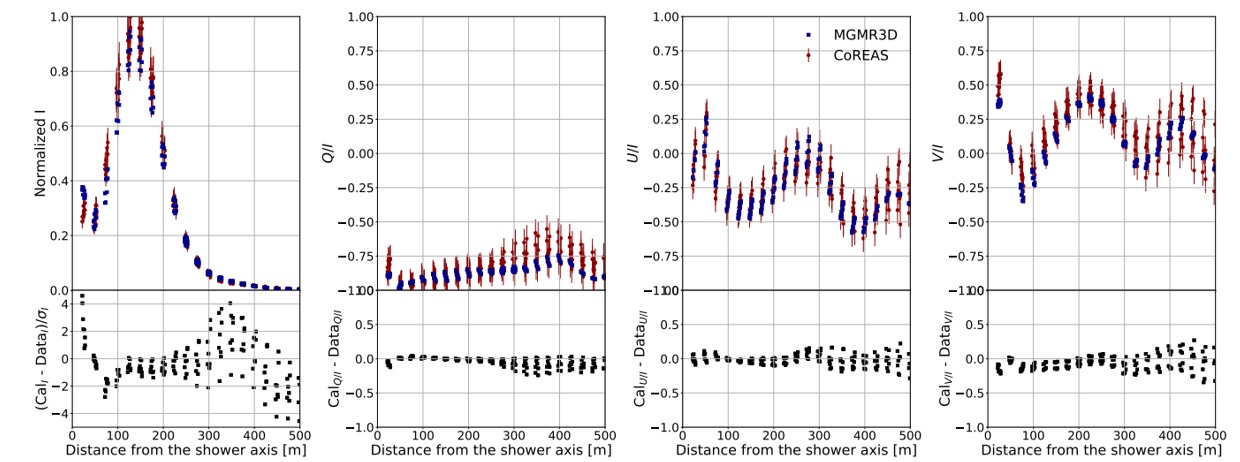
The Stokes parameters obtained from MGMR3D calculation (filled blue dots) are compared to the ones obtained from CoREAS (filled red circles) for Event 1. σ is one standard deviation error.
Nine parameters of the electric field and the value of Xmax of Event 1
|
Layer |
h [km] |
E [kV/m] |
| |||
|
CoREAS |
MGMR3D |
CoREAS |
MGMR3D |
CoREAS |
MGMR3D | |
|
1 |
8 |
9.3 |
35 |
32 |
-40 |
-34 |
|
2 |
4.9 |
5.3 |
18 |
13 |
-121 |
-116 |
|
3 |
3.2 |
3.5 |
96 |
123 |
23 |
17 |
|
XmaxCoREAS [g/cm2] |
653 | |||||
|
XmaxMGMR3D [g/cm2] |
660 | |||||
Event 2
Figure 2 presents the Stokes parameters of the MGMR3D calculations and the ones from CoREAS. The radio intensity profile shown in the left panel of Figure 2 looks like the one for a fair-weather event. The dip in intensity near the core is an indication of some destructive interference between the emissions from different layers, thus there is a similar orientation of the electric field at a large angle to the geomagnetic force. As can be seen from the two middle panels, Q/I is not equal to 1 and U/I is about 1 which means that the polarization of the signals at all antenna positions, at 45 degrees, is rather different from the one of a fair-weather event, which is mostly at 0 degrees. The amount of circular polarization is small for this event as shown in the right panel of Figure 2. The results from MGMR3D and the ones from CoREAS agree rather well, except at distances beyond 300 m where the intensity of the radio radiation are rather small. At small distances, the discrepancies are about 1σ. At distances larger than 250 m, they are less than 4σ.
Table 2 shows the values of Xmax obtained in both the codes and values of the electric fields. The value of Xmax was obtained from MGMR3D, and the true value differs by 9 g/cm. The structures of the electric fields were derived from both codes containing three layers. The discrepancy in the thickness of each layer is less than 0.6 km. The values of the field strength from MGMR3D and CoREAS in all three layers are also close to each other. Similarly, the directions of the electric fields in all layers from the two codes are almost the same.

The Stokes parameters obtained from MGMR3D calculation (filled blue dots) are compared to the ones obtained from CoREAS (filled red circles) for Event 2. σ is one standard deviation error.
Nine parameters of the electric field and the value of Xmax of Event 2
|
Layer |
h [km] |
E [kV/m] |
| |||
|
CoREAS |
MGMR3D |
CoREAS |
MGMR3D |
CoREAS |
MGMR3D | |
|
1 |
7.8 |
8.2 |
53 |
62 |
-12 |
-10 |
|
2 |
5.5 |
6.1 |
47 |
40 |
17 |
13 |
|
3 |
2.2 |
2 |
5 |
3 |
3 |
4 |
|
XmaxCoREAS [g/cm2] |
611 | |||||
|
XmaxMGMR3D [g/cm2] |
620 | |||||
Event 3
Figure 3 shows the comparison between the Stokes parameters obtained from CoREAS and those from MGMR3D for Event 3. The peak in the radio intensity for Event 3, seen on the left panel of Figure 3, is reached at distances of 100 m, indicative of a strong interference due to the radiation from the different layers. The parameters of the electric fields and the value of Xmax are given in Table 3. As presented in this table, in both MGMR3D and CoREAS, the electric fields in layers 1 and 2 are oriented in almost opposite directions. Therefore, the radio emissions of the air shower from these two layers interferes destructively. As a result, there is a ring-like structure in the intensity footprint. The differences in the field strength and its orientation between MGMR3D and CoREAS are large, as shown in Table 3. This event in the air shower can be considered to pass through a two-layer electric field since the bottom layer is thin.

The Stokes parameters obtained from MGMR3D calculation (filled blue dots) are compared to the ones obtained from CoREAS (filled red circles) for Event 3. σ is one standard deviation error.
Nine parameters of the electric field and the value of Xmax of Event 3
|
Layer |
h [km] |
E [kV/m] |
| |||
|
CoREAS |
MGMR3D |
CoREAS |
MGMR3D |
CoREAS |
MGMR3D | |
|
1 |
8.3 |
8.1 |
69 |
77 |
61 |
60 |
|
2 |
3.9 |
3.7 |
19 |
27 |
-134 |
-123 |
|
3 |
0.3 |
0.4 |
15 |
97 |
-20 |
-77 |
|
XmaxCoREAS [g/cm2] |
550 | |||||
|
XmaxMGMR3D [g/cm2] |
540 | |||||
Discussion
The intensity footprints of Events 1 and 3 show a ring-like structure. The antennas far away from the core of the shower receive the radio signals at high altitudes in the atmosphere, while the ones near the core get signals from the whole air shower. For that reason, at small distances near the shower axis, when the electric fields in two layers are about opposite as seen in Event 1 and Event 3, there is destructive interference between the radio emissions from the two layers, resulting in a ring-like structure. The diameter of the ring is strongly correlated with the height where the electric field changes, as discussed in5. The intensity of Event 2 looks like the one seen in fair-weather events.
However, Event 2 is different from fair-weather events because the linear polarization point causes an angle of about 45 degrees toward the vxB-direction. The linear polarization in Event 1 is also typical for thunderstorm events. While Q/I is almost equal to -1 for all distances, U/I varies from 0 to -0.5. Thus, the linear polarization also rotates from 0 to about 60 degrees. This polarization footprint is also seen in6. Event 3 has a simple linear polarization because the polarization angle is about -30 degrees for all antenna positions.
The circular polarization in Events 2 and 3 almost vanish because the electric fields in these two events have the same direction or they are inverted. There is no rotation of the electric fields, which gives rise to the circular polarization.
The comparison between CoREAS and MGMR3D in three events shows that the discrepancy seen in the height of the top layer is large, about 1.5 km. At high altitudes, the shower is young, so there are not many particles. Thus, the contribution of radio radiation from these heights is small. As a result, we lose the sensitivity to them 6, 12. For the heights of the middle and the bottom layers, the differences are much smaller, about 0.5 km.
The discrepancy of the electric field strength is usually smaller than 10 kV/m, meaning that the field strength is very well-defined. However, there are two cases where the differences are large. The first one is seen in the bottom layer of Event 1. As discussed in 5, 6, when the field strength is larger than 60 kV/m, the radiation amplitude starts to saturate. Therefore, we also lose sensitivity. The second one appears in the bottom layer of Event 3. The thickness of this layer is small, 0.3 km, thus the radiation from this layer is very small. As a result, we lose sensitivity in this layer and we cannot derive the strength and direction of the electric field in this layer. The angle α of the electric field in this layer is thus also poorly determined. For the rest, the angle α is determined with uncertainties at less than 10 degrees, which is comparable to what is shown in11.
Conclusions
During thunderstorm conditions, radio radiation due to the extensive air showers is affected by the atmospheric electric fields in the clouds. These effects are implemented in both macroscopic and microscopic models, i.e., MGMR3D and CoREAS. We have engaged in a comparison of the radio emissions from extensive air showers passing through complicated electric fields generated from CoREAS and MGMR3D. The results show that there is a good agreement between MGMR3D and CoREAS. However, there are some limitations due to the nature of the air showers. First, we lost sensitivity to the layer of the electric field when the layer was too thin or the shower too young. Second, we also cannot determine the strength of the electric field well if the strength is larger than 60 kV/m. Besides these limitations, we have shown that MGMR3D determines the electric field accurately. As a result, MGMR3D can be used to determine the structure of the electric fields drawn from the real data of radio emissions as part of extensive air showers.
Abbreviations
Author contributions
Trinh Thi Ngoc Gia, Dang Trung Si and Nguyen Thi Kim Ngoc did the simulations and analysis. Trinh Thi Ngoc Gia and Nguyen Thanh Phong wrote the manuscript and made the corrections.
Acknowlegdement
This research is funded by Vietnam National Foundation for Science and Technology Development (NAFOSTED) under Grant No. 103.01-2019.378.
Competing interests
The authors declare that they have no competing interests.